
Lesson 18 · Progress report
Business English · 50-minute live lesson
Your fluency stayed strong during the role-play. Next, focus on irregular past-tense forms when explaining completed projects.
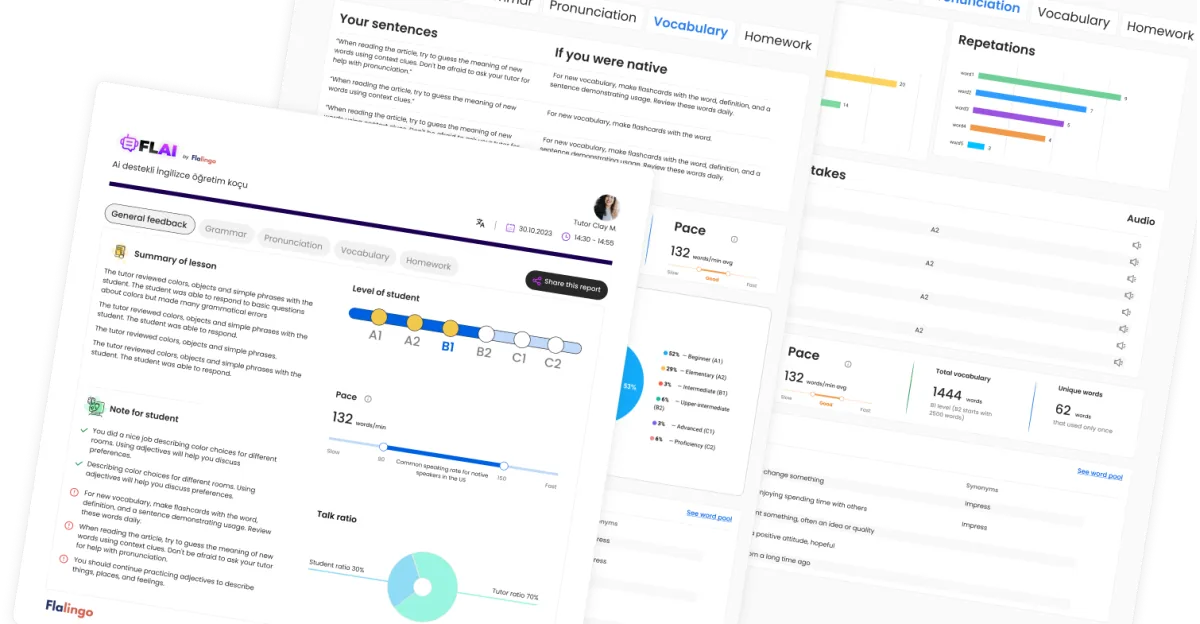
FLAI analyzes evidence from English lessons and assessments to measure learner progress, improve teaching quality, and create personalized feedback and next-step plans—for learners, tutors, and academic teams.
Business English · 50-minute live lesson
Your fluency stayed strong during the role-play. Next, focus on irregular past-tense forms when explaining completed projects.
Most platforms can confirm that a lesson happened. FLAI helps education teams understand the learner, improve the lesson, and continue with a plan built from the actual interaction.
Assess performance with lesson context, not with a disconnected score alone.
Give tutors and academic teams consistent signals for better teaching and coaching.
Turn feedback into focused practice and a practical plan for the next lesson.
FLAI already turns live lessons into summaries, level signals, pace, talk ratio, vocabulary, corrections, learner feedback, and tutor notes. This partner direction extends that foundation into a complete learning-intelligence layer.
The teacher remains at the center of the learning experience. FLAI keeps useful signals from disappearing when the call ends.
The intelligence layer inside the learning loopLive speech, lesson context, goals, and eligible interaction data create the learning record.
Performance, errors, vocabulary, fluency, participation, and lesson-quality signals are structured.
The learner gets clear corrections; the tutor gets practical guidance for what to do next.
Practice, homework, and the next lesson focus reflect what the learner actually needs.
Continuous lesson intelligenceClear progress and a focused next step after every lesson.
You communicated your project update clearly and used linking phrases confidently. Your next priority is choosing the correct past-tense form when describing completed work.
Practical guidance based on the learner’s performance and the lesson interaction.
Contrast past simple with present perfect using project-status updates. Ask the learner to retell two completed actions and one ongoing result.
The learner had enough space to complete extended answers.
Consistent evidence for coaching and review—not an automatic verdict.
| Area | Signal | Data quality |
|---|---|---|
| Student participation | Healthy | Sufficient |
| Questioning & elicitation | Effective | Sufficient |
| Correction timing | Review | Partial |
| Goal relevance | Aligned | Sufficient |
Review two interruption points during the fluency task. The signal is prepared for an academic reviewer; the final coaching decision remains human.
FLAI can measure where a learner is now, explain the result, and turn it into a better next step—across adults, children, exam preparation, and speech diagnostics.
Run full or section-based mock journeys across Listening, Reading, Writing, and Speaking. Objective sections use answer-key scoring; productive responses can receive criteria-based AI evaluation, error explanations, and a personalized study focus.
Band-style results with criteria-led Writing and Speaking feedback.
Integrated-task evaluation with section and total-score views.
Case-note Writing and clinical role-play Speaking within the full exam flow.
Eight targeted questions adjust to every response. Grammar, vocabulary, reading, cohesion, and functional language shape the estimate; B1+ learners continue to a short speaking check.
A read-aloud and a short spontaneous response produce an accent-strength score and native-reference similarity—useful for pronunciation coaching and speaking programs.
Age and reading ability select the right path before testing begins. Ages 4–6 start with audio and pictures; older children are guided by how comfortably they can read English.
A 12-question adaptive path measures grammar, vocabulary, reading, cohesion, and functional language. Emerging readers can hear questions with audio support.
No reading required. Ages 4–6 begin here automatically; older non-readers can also use listening, pictures, simple instructions, and short stories. Parents receive a stage estimate and next-step guidance.
Placement estimates and mock results support instructional decisions and exam practice; they are not official CEFR certificates or exam-provider scores. Accent is treated as a speech characteristic—not a flaw.
Start with the lightest delivery path that proves educational value. Productize further only when the workflow justifies it.
A scoped pilot can define eligible lesson inputs and a structured result contract for your own product workflow.
Scoped pilot contractGive learners, tutors, and academic teams a role-specific feedback experience without building every view first.
Pilot-shaped deliveryShape a hosted learning or assessment journey when a design partnership proves the participant experience.
Demand-led partnershipFLAI should help people teach and learn better. It should not hide uncertainty or replace accountable academic judgment.
Findings stay connected to transcript, response, rubric, lesson context, or measurable interaction data.
Weak media, missing context, or limited learner evidence produces a warning or partial result—not invented certainty.
Tutor coaching, content publication, placement, and employment decisions remain with accountable people.
Pilots begin only with data the partner is authorized to share, with additional safeguards for child learner data.
We map the learner outcome, lesson-quality signals, feedback views, data boundaries, and the smallest pilot worth running.
No. Assessment is one part of a continuous learning loop. FLAI is designed to turn lesson evidence into learner feedback, tutor guidance, quality signals, personalized practice, and the next learning plan.
The existing exam engine covers IELTS Academic and General Training, TOEFL iBT, and OET workflows for Medicine, Nursing, Dentistry, and Pharmacy. Full or section-based practice can include answer-key scoring plus criteria-based Writing and Speaking evaluation. Partner programs can also scope PTE, TOEIC, YDS, YÖKDİL, or custom assessment blueprints.
The assessment path changes before testing begins. Children who read use adaptive, age-appropriate questions with optional audio support. Pre-readers use listening, picture selection, instruction-following, and short-story tasks with no reading requirement; parents receive a broad readiness stage and recommended next step.
Not as a broad public product. Delivery is shaped through focused design partnerships so the result contract, data permissions, learning workflow, and review boundaries are validated before wider productization.
No. Practice and diagnostic outputs are not official exam-provider scores or certifications. Tutor-quality and English-interview signals can support a qualified reviewer, but hiring, rejection, disciplinary, and academic decisions remain human.
Only lesson or assessment data the partner is authorized to share for the agreed purpose. Data quality, retention, access, and review requirements are defined before processing; child learner data requires additional safeguards, and adult accent analysis requires explicit voice consent.